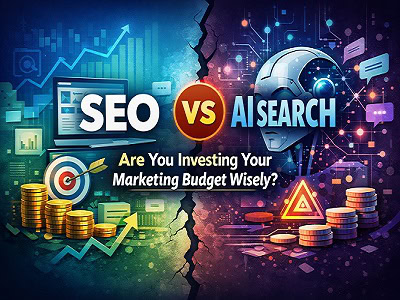
SEO vs AI search in 2026 - Are you investing budget wisely?

SEO vs AI Search in 2026: What Actually Drives Growth (and Where to Invest)

There is a huge amount of noise right now around “AI search”, “optimising for ChatGPT”, and “the future of SEO”. For many businesses, it creates a simple but critical question:

Should we be shifting budget away from SEO into AI-driven strategies?

The short answer – based on current data and real-world performance – is:

NO. SEO remains the primary driver of traffic, visibility, and revenue. AI is influencing behaviour, but it is not replacing search.

This article breaks down exactly what the data shows, what it actually means, and where you should focus your investment.

The Data: Organic Search vs AI Traffic

Let’s start with the reality.

  • Organic search drives ~46-50% of all website traffic (SE Ranking, DemandSage)
  • AI-driven sources (ChatGPT, Perplexity, etc.) account for ~0.1%-0.5% of referral traffic (Sunny Patel)

In simple terms:

Organic search is still between 100x and 500x larger than AI as a traffic source

What this means commercially

If your objective is:

  • Generating leads
  • Driving ecommerce sales
  • Building pipeline

Then:

SEO is still your most important acquisition channel-by a significant margin

AI is not currently a scalable traffic source.

Why Organic Search Still Dominates

This isn’t just about numbers—it’s about how users behave.

Search engines like Google are embedded into everyday behaviour:

  • Built into browsers (Chrome, Safari)
  • Default on mobile devices
  • The starting point for most online journeys

Research consistently shows:

  • ~68% of online experiences begin with a search engine (AI SEO)

The key advantage: intent

Search captures active intent.

When a user searches:

  • “buy [product] online”
  • “[material/service] supplier/manufacturer”
  • “[product category] solutions”

They are:

Actively looking to solve a problem or make a purchase decision

Why this matters

SEO doesn’t just generate traffic – it generates:

  • Qualified users
  • Commercial intent
  • Measurable revenue

Why AI Traffic Is Still So Small

Despite the hype, there are structural reasons why AI has not become a major traffic driver.

1. AI is designed to answer, not send traffic

Search engines:

  • Show results
  • Encourage clicks

AI systems:

  • Provide direct answers
  • Reduce the need to click

Example:

Search journey:

User searches → reviews results → clicks website

AI journey:

User asks → gets answer → stops

This fundamentally limits traffic potential.

2. AI cannot replace commercial journeys

For most industries -especially enterprise and B2B- buyers need:

  • Detailed product specifications
  • Installation guides
  • Compliance documentation
  • Certifications (e.g. BBA, ISO)
  • Supplier validation

AI summaries cannot replace this level of detail.

3. AI depends on existing web content

AI models:

  • Do not independently discover content
  • Rely on indexed, structured, authoritative sources

Which means:

AI visibility is built on SEO foundations

4. Measurement is still immature

AI traffic:

  • Is inconsistently tracked
  • Lacks clear attribution
  • Cannot be reliably forecast

Making it difficult to justify significant investment

The Real Shift: Click Behaviour Is Changing

While AI traffic is small, its impact on user behaviour is real.

Zero-click search is rising

~60% of searches now end without a click (Position Digital)

AI Overviews reduce click-through rates

  • CTR drops from ~15% to ~8% when AI summaries appear
  • That’s a ~47% reduction in clicks

Other studies show:

What this actually means

You can still rank – but fewer users may click

Not All Queries Are Affected Equally

This is a critical nuance.

Informational queries

Example:

“what is a [product type]”

High impact:

  • AI answers the question
  • Click often unnecessary

Commercial queries

Example:

  • “[product] supplier / manufacturer [location]”

Lower impact:

  • Users still need options
  • Users still compare suppliers

Transactional queries

Example:

  • “buy [product] [size / material]”

Minimal impact:

  • AI cannot complete the transaction
    Users must visit a site

Strategic takeaway

The closer a query is to revenue, the less AI disrupts it

The Paradox: AI Traffic Converts Better

Some data shows:

  • AI traffic conversion rates ~14%
  • Organic search ~2–3%

Why?

Because AI users:

  • Are more informed
  • Are further along the journey
  • Have clearer intent

But here’s the key point:

High conversion rate does not equal high revenue

Because:

  • Volume is extremely low

AI is efficient – but not scalable

Example:

Channel

Traffic

Conv. Rate

Leads

SEO

10,000

3%

300

AI

100

14%

14

The Biggest Misconception: “AI SEO” Is New

Much of what is being sold as “AI optimisation” includes:

  • Structured content
  • Clear answers
  • Internal linking
  • Schema markup
  • Entity clarity

These are not new

They are:

Core SEO fundamentals

Supporting evidence

Research shows AI visibility is driven by:

  • Authority
  • Links
  • Brand signals
  • Content quality

Not standalone “AI tactics”

Sure there are some checks such as making sure Chatbots are not blocked in the websites robots.txt file from crawling your website or that CloudFlare is not blocking these (where used), but an SEO consultant should have the skillset to check and support with this.

The Role of Schema (And Its Limits)

Schema is important – but often misunderstood.

What schema does well:

  • Defines entities
  • Supports structured understanding
  • Enables rich results

What it does NOT do:

  • Build authority
  • Improve rankings alone
  • Replace content quality
  • Fix technical issues

Correct perspective:

Schema supports SEO – it does not replace it

Where Businesses Are Getting It Wrong

  1. Treating AI as a separate strategy → Leads to duplication and wasted budget
  2. Investing in tools instead of fundamentals → Tools don’t fix structural issues
  3. Ignoring commercial intent → Traffic without revenue
  4. Reacting to hype instead of data → Misallocated investment

Where You Should Invest Instead

Priority order:

  1. Technical SEO & architecture:
    Crawlability
    Indexation
    Internal linking
    Taxonomy
  2. Content aligned to intent:
    Product-level visibility
    Commercial keywords
    Supporting informational content
  3. Authority & trust
    Backlinks
    Brand signals
    Industry presence
  4. Structured data (schema)
    Enhances both search and AI visibility
  5. AI considerations
    Content clarity
    Answer formatting
    Entity reinforcement

The Strategic Conclusion

Let’s be direct.

  • Organic search = ~50% of traffic
  • AI traffic = <1%

Therefore:

Shifting significant budget into AI-first strategies is not commercially justified right now

The correct approach:

Invest in SEO done properly and you will naturally perform in AI environments

The Simplest Way to Explain It

SEO gets you found
AI changes how users interact with what they find

Final Takeaway

  • SEO remains the dominant growth channel
  • AI is influencing behaviour – not replacing traffic
  • Most “AI SEO” is simply good SEO, repackaged
  • The real risk is underinvesting in SEO fundamentals

Bottom line:

If your SEO is strong, you are already positioned for AI

You do not need a separate AI strategy – you need better SEO execution

Are you spending your marketing budget wisely?

If your investment is shifting towards AI without a strong SEO foundation, you may be prioritising hype over measurable growth.

Speak to Weston Dynamics and let’s take a closer look at where your strategy is delivering value – and where it isn’t.